

Blab
- 2024.04.25
- Neurodiversity Project: First Training Session
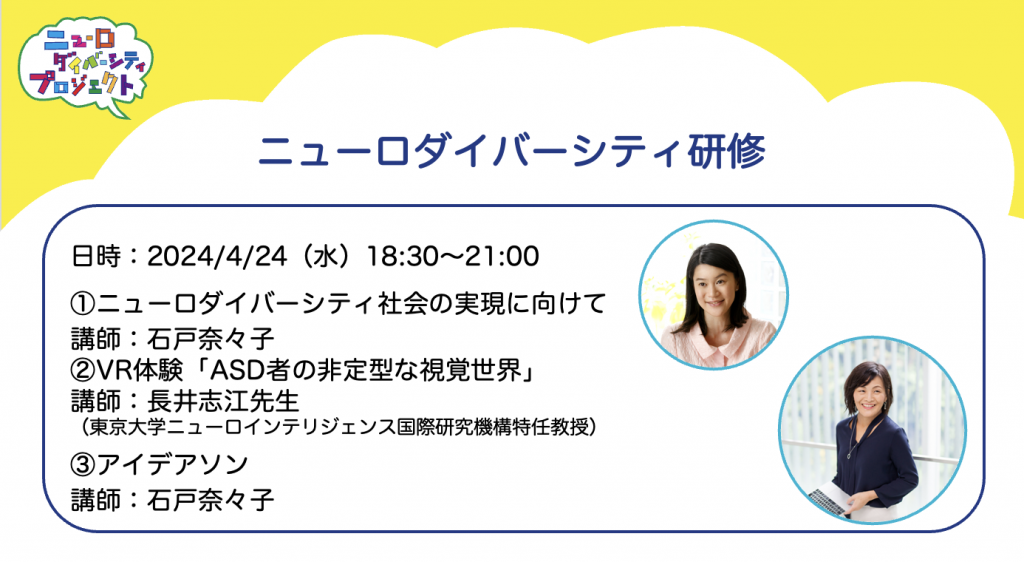
We held the first training session for the Neurodiversity Project. I gave a presentation on the following topics.

We launched the Neurodiversity Project a year ago.
Consistent with our mission to “build a society where every individual can realize their full potential,” we are working toward the realization of a society characterized by Neurodiversity.
We believe that promoting neurodiversity can unlock new creativity in everyone and contribute to the development of society as a whole, and we are working to make this a reality.
In carrying out this project, we are implementing our activities—whether through exhibitions or training—based on three frameworks.
1. The Five Senses in All Their Diversity: Utilizing technology to share diverse perspectives on the world through hands-on experiences and broaden our horizons
2. Enhancing the Individual & Adapting the Environment: To resolve the difficulties individuals face in daily life and build a society where everyone can reach their full potential, we will pioneer methods for using technology to enhance the individual and adapt the environment.
3. Creating Society: We encourage everyone to take a proactive role in shaping society and to take concrete actions toward realizing a neurodiverse society.
During the first training session, we will hold an ideathon where participants will use VR-based experiences to share in the visual world of individuals on the autism spectrum, learn about a neurodiverse society achieved through personal empowerment and environmental adjustments, and brainstorm actions to take.
In other words, this training program combines the approaches of “learning,” “experiencing,” and “creating” with the goal of helping participants deepen their understanding of neurodiversity and translate that understanding into concrete actions.
Neurodiversity refers to diversity stemming from the brain and nervous system, as distinct from other forms of diversity such as race, age, and gender.
Because of differences in the brain and nervous system, each person has unique characteristics. Let’s respect that diversity, harness those differences for the benefit of society, and promote social inclusion. That is what we aim to achieve.
The term “neurodiversity” was first used in the late 1990s by an Australian sociologist who is on the autism spectrum (ASD). Coinciding with the spread of the internet, it grew into an online community where people on the spectrum could connect with one another.It began as a rights movement for neurological minorities led by people with ASD. Subsequently, the movement expanded to include not only those with ASD but also people with neurodevelopmental conditions in general, and eventually evolved into “neurodiversity”—a term that refers to a way of thinking that respects the diversity stemming from every individual’s brain and nervous system and seeks to harness that diversity in society.
Our initiative also recognizes that brain and neurological diversity applies to all of us, and we are working to make it an initiative that is open to everyone.
On the other hand, as evidenced by the fact that the neurodiversity movement was initiated by those directly affected, it has become clear that there are people who suffer from difficulties in daily life, interpersonal relationships, and social adaptation, and that brain diversity is one of the underlying factors contributing to these challenges. In light of this, I would like to touch on neurodevelopmental disorders (commonly referred to as developmental disabilities).
It is estimated that one in ten people has a tendency toward neurodevelopmental disorders. There are three major types of neurodevelopmental disorders: autism spectrum disorder (ASD), attention-deficit/hyperactivity disorder (ADHD), and specific learning disorder (SLD).ASD is characterized by difficulties with communication, challenges in interpersonal relationships, social difficulties, and repetitive behaviors or obsessions. ADHD is characterized by inattention, hyperactivity and talkativeness, and impulsive behavior.SLD is primarily characterized by difficulties with reading and writing. However, these are only the main characteristics; neurodevelopmental disorders present a wide variety of traits—as unique as the individuals themselves—and vary from case to case.
These characteristics can cause various problems in daily life.
For example, during one’s student years, issues such as a lack of focus, difficulty staying organized, and problems with interpersonal relationships may arise. In adulthood, mistakes at work, difficulties with housework or child-rearing, and trouble understanding the feelings of others—such as a partner or children—may occur.
As you repeatedly face these issues, your self-confidence may decline, and you may feel isolated or find it difficult to cope with life.
They are sometimes treated as “troublesome people,” but they are not “troublesome people”—they are “people facing difficulties.”Against this backdrop of brain diversity, when individuals are unable to fully demonstrate their “potential” and face difficulties in various situations, they are often labeled as having a developmental “disability,” and their personal characteristics are frequently perceived as the problem. However, the “difficulties in living” that people experience arise from the interaction between individual characteristics and the environment.
It is said that many of the geniuses who achieved the greatest inventions of the century had brains that differed from the norm. For example, renowned entrepreneur Elon Musk and film director Steven Spielberg have both publicly disclosed that they have developmental disabilities.However, by placing themselves in environments that capitalize on their unique traits, these developmental differences have actually become “strengths” for them. People with exactly the same traits may, depending on their environment, become charismatic business leaders or face difficulties in the workplace. Thus, it is important to view this as an interaction between an individual’s traits and their environment.
For example, some people have a high Autism Spectrum Quotient (AQ) but have not been diagnosed, while others have a low AQ but have been diagnosed. In other words, a change in environment can lead to a diagnosis of a developmental disorder or the removal of such a diagnosis.Depending on the context, people who exceed a certain threshold may be labeled as having a “disability” or “illness,” but there is no sharp, clear-cut boundary between disability and neurotypicality, or between illness and health—it is a continuous spectrum.This is precisely why neurodiversity is an important concept not only for people with neurodevelopmental traits but for everyone seeking to live a rich and authentic life. Furthermore, anyone can potentially become a minority if their environment changes. For example, if you cannot speak English, communicating in an English-speaking country becomes difficult, and as you age, getting around may become challenging.When the environment is not adapted to one’s physical and mental capabilities, a barrier arises between the person and their environment.
We believe that by respecting each individual’s unique characteristics and providing the right environment, we can turn what has traditionally been viewed as a “disability” into a “strength.”
The concept of neurodiversity is also gaining traction in other countries. In Australia, efforts are underway to expand employment opportunities for people with ASD by improving the employment environment. At the same time, the Department of Defense is working to leverage the strengths associated with neurodevelopmental traits—such as by hiring individuals with these traits as cybersecurity analysts—to strengthen cybersecurity measures.Furthermore, the Canadian government has invested more than 150 billion yen in cutting-edge research institutions in fields such as ASD.
In the corporate world, particularly in the IT sector, individuals with neurodevelopmental traits often demonstrate exceptional talent; as a result, initiatives to actively recruit people with these traits and create a supportive work environment are spreading both domestically and internationally.Since a 2017 article in *Harvard Business Review* highlighted the contributions of individuals with neurodevelopmental traits in IT companies, these initiatives have expanded even further. The magazine also reported that teams rich in neurodiversity demonstrate higher productivity.
We are undertaking this project because we believe that creating a neurodiverse society will contribute to fostering innovation and improving productivity.
When it comes to the workplace, the message I want to convey is,
・It is important to create a work environment where people with diverse characteristics can work comfortably.
・As a result, individuals who have previously found it difficult to work but who excel in specific fields can make significant contributions to a company’s productivity and innovation.
・Furthermore, a work environment that is conducive for people with neurodevelopmental conditions is also conducive for many other people.
That's it.
(We would also like to note that, effective April 1, 2024, private-sector businesses are now required to provide “reasonable accommodations” to people with disabilities.)
By deepening our understanding of neurodiversity, we can create a society where everyone can work comfortably, live easily, and reach their full potential. Furthermore, it is crucial for everyone to actively participate in creating this new society—and it is with this goal in mind that we are advancing this project.The specific approach of this project involves using technology to supplement and augment individual brain functions and physical capabilities, while redesigning the environment—including physical spaces, social institutions, and customs—from a diversity and inclusion (D&I) perspective.By harnessing the power of technology to respect individual characteristics and create appropriate environments, we aim to eliminate the “difficulties of daily life” and transform individual traits into “strengths,” thereby bringing us closer to realizing a neurodiversity society.
Technology complements and enhances individual brain function and physical abilities. A variety of tools complement and enhance the “powers” that each of us possesses.
Take eyeglasses, for example. In the past, people with poor eyesight might have been considered disabled. However, no one views them that way anymore. Today, eyeglasses are also used as fashion accessories. The same is true for prosthetic limbs and hearing aids. Furthermore, wheelchairs are no longer limited to people with mobility impairments or the elderly; new forms of personal mobility are emerging that enable a wide range of people to move about freely.
Most recently, technologies that enhance brain function—such as brain tech—have been advancing rapidly. The adoption of these technologies makes it possible to improve quality of life and help individuals realize their full potential.As technology and the human body merge and continue to evolve together, our potential expands infinitely. We are committed to developing technologies that enhance the individual and encourage each person to realize their full potential.
Creating an environment—including physical spaces, social institutions, and customs—from a D&I perspective. While square tires have difficulty traveling on smooth roads, they can move more smoothly than round tires on bumpy roads. In other words, the strengths required vary depending on the environment.It is entirely possible that a strength considered a disability in one place or era could be valued as an extremely valuable asset in another place or era.
People with color vision deficiencies cannot distinguish the colors of traffic lights, which causes difficulties in their daily lives. But what if traffic lights were a different color? Or what if they could be distinguished through a combination of shape, sound, or other cues? Then, those difficulties would likely disappear.
Some children are unable to wear their school uniforms—due to reasons such as skin irritation or the weight of the uniform—and this prevents them from attending school. What if there were no school rules requiring them to wear those uniforms? Reviewing school rules and adopting a more flexible approach might make it possible for them to attend school.
Our daily lives are influenced by our physical environment, social systems, rules and customs, and interpersonal relationships.By rethinking and redesigning the environments we currently take for granted to ensure they are appropriate for everyone, we aim to alleviate the difficulties people face in daily life and build a society where everyone can more easily realize their full potential. For
example, what if people who find it difficult to be in crowded places—due to auditory sensitivity or other reasons—could attend school or commute via online platforms or the metaverse? That, too, is one way of living.If there is a greater diversity of choices in how we live, learn, and work, we can address the challenges people face.
Our team members are working on various implementations by combining one or both of these approaches.
There are likely many actions we can take to realize a neurodiverse society.
Experiences offered through training sessions and exhibitions—which utilize the unique ways individuals perceive and feel things that stem from brain diversity—aim to foster mutual understanding of different perspectives and respect for diverse ways of viewing the world.
In addition, during the ideathon—which uses “Challenge Cards” describing the difficulties people with neurodevelopmental disorders face in their daily lives—participants are encouraged to think about how they would respond if they were in that situation.
This ideathon has three objectives.
1. Recognizing
the Situation of People Facing Difficulties
By looking at the card, you will likely realize that there may be people around you who are in similar situations. We hope that this will help you come to see people you previously viewed as “troublesome” as people who are actually “in need of help.”
2. Realizing
That Everyone Is a Participant
By looking at the cards, you’ll likely realize that some of the traits described apply to you as well. Traits exist on a spectrum, and everyone possesses a variety of them. Furthermore, as you gain a deeper understanding of yourself, you’ll be able to create an environment that makes life easier for yourself.
3. Realizing that there are things you can do yourself. With a
little creativity, anyone can take a step toward realizing a neurodiverse society. I believe that when everyone takes an active role in this effort, we will move closer to creating a society where more people can live more comfortably.
I hope that an understanding of the concept of neurodiversity as described above, experiences of diverse sensory perceptions, and the insights gained through the ideathon will provide new perspectives and serve as a source of innovation that enriches the world.
Profile
-

Digital Picture Book Author Professor, Keio University; Ph.D. (Policy and Media)
Director, B Lab
Chairperson, Learning of Tomorrow (General Incorporated Association)
Chairperson, CANVASAfter graduating from the Faculty of Engineering at the University of Tokyo, he served as a visiting researcher at the MIT Media Lab before founding the NPO CANVAS and the Learning of Tomorrow Association, a General Incorporated Association, and assuming the role of representative. He serves as an outside director for Matsuya Co., Ltd., Fuji Media Holdings, Inc., and Digital Garage, Inc.
He has served on various government committees, including the Information and Communications Council of the Ministry of Internal Affairs and Communications, as well as the NHK Central Broadcasting Program Council. He also serves as a director of the Digital Signage Consortium, among other roles. He holds a Ph.D. in Policy and Media.
His publications include *Turning On Children’s Creativity!*, *What Are Smart Kids Doing on Their Smartphones?*, *The Forefront of Online Education in Japan: Considering Learning in the Post-COVID Era*,“What Is Programming Education? 45 Questions Parents Want to Know,” and “Declaration on Digital Education.” He has also provided supervision for numerous works, including “Ah, I See! Programming Education for Parents and Children Through Manga.”























4052047885.jpg )