




Blab
- 2023.07.29
- Introduction to the CHO KOUKA Project

I spoke to the residents of Kuwana City about the "CHO KOUKA" Project.
The CHO KOUKA Project collects school songs from elementary, middle, high, and universities across the country, trains an AI on them, and builds a program that uses the AI to generate music and lyrics, providing schools nationwide with an opportunity to reevaluate and rearrange their own school songs.This initiative seeks to explore new forms of school songs that can evolve to suit an era of diversifying values.
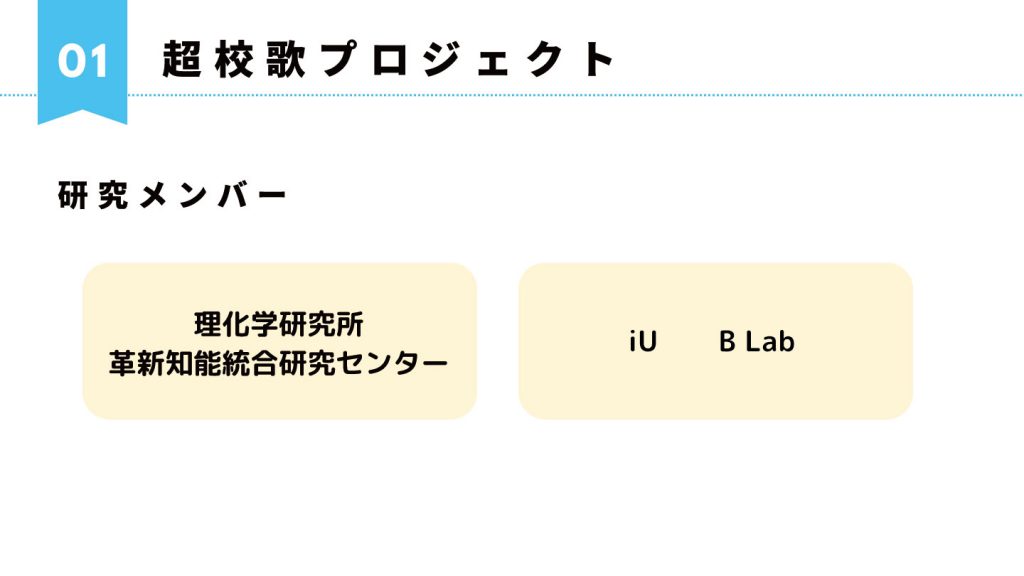
When it comes to AI research, Japan’s leading institution is the RIKEN API Research Institute, along with iU University—which opened in Sumida Ward, Tokyo, in 2020 to cultivate innovation talent and entrepreneurs—and “B Lab”—a research hub centered around iU where all kinds of organizations and individuals collaborate to collectively build an exciting future—are conducting joint research.
School songs have evolved as a unique aspect of Japanese school culture. While most elementary and secondary schools in Japan have adopted school songs, they are rarely found in schools in Europe, the United States, and other parts of the world.
It is said that these songs originated as part of the Meiji government’s educational reforms, introduced to unify values and ideologies; however, it is also said that later on, lyrics describing the surroundings of schools and local communities—which had been almost nonexistent at first—began to appear, and the songs came to be characterized as “local folk songs” with a more distinctive character.
Japanese school songs have come to be sung not just within the confines of the school, but as songs that foster a connection to the local community. Now, a century later, in the Reiwa era—marked by rapid technological advancements and increasingly diverse values—we will use AI technology to collectively explore the evolving role of school songs, while considering what songs children want to hear today andand what school songs they want to sing? Using AI technology, we will work together to explore the evolving nature of school songs.
Our goal is to provide schools across the country with an opportunity to reevaluate and rearrange their own school songs after we develop a program that uses AI to write the lyrics and compose the music for school songs. Earlier this fiscal year, we received a message from the mayor and members of the Board of Education in Kuwana City expressing their strong desire to collaborate with us.
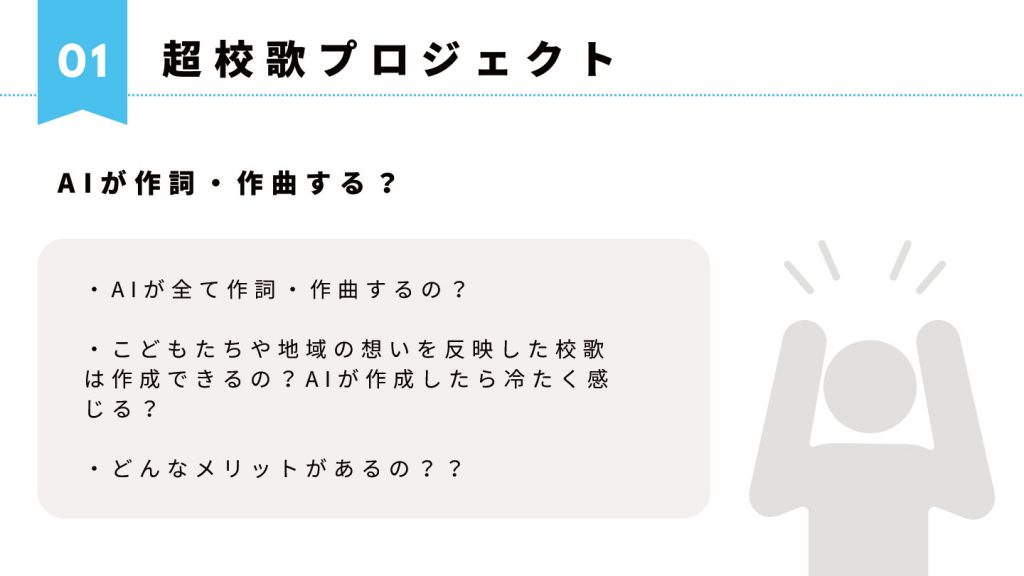
Some of you may feel uneasy upon hearing that AI will be writing the lyrics and composing the music for our school song.Some of you may be wondering if we’ll be leaving the entire process of creating the school song to AI, or if it’s possible to create a school song with a unique character that will be loved by the local community. Others may be asking, “Why are we using AI to create a school song in the first place?” So, I’d like to start by explaining the basic concept behind this project.

Traditionally, composing a school song has been a very daunting task for beginners, so I believe it was common to commission professional musicians who were either locals or had ties to the school.
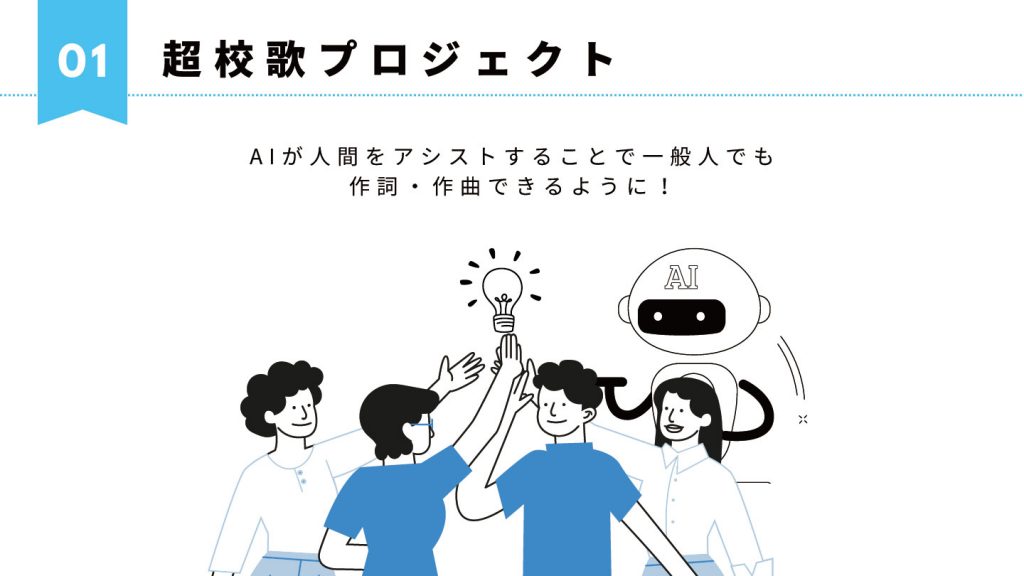
The release of the generative AI ChatGPT at the end of last year provided an opportunity to reevaluate existing practices and conventions. Thanks to advances in AI technology—as exemplified by the creation of school songs—even members of the general public can now write lyrics and compose music through collaborative creation between AI and humans.

AI is often described as a co-pilot to a human pilot, but it is “humans” who utilize and assemble the AI’s suggestions, infuse them with human emotion, and bring the song to life.The CHO KOUKA Project will also be carried out under the concept of “co-creation between humans and AI.” We invite everyone who knows Tado best and has a special connection to the town to participate. Together with the AI program, we will create a school song through collaboration with the AI. Of course, even if you aren’t necessarily knowledgeable about music, lyric writing, or composition, you’re more than welcome to join us.
So, if you’re worried that entrusting the entire process of creating the school song to AI might result in a song that lacks originality, please rest assured. Of course, the AI will generate a preliminary draft to serve as a starting point, but this is ultimately a “collaboration between humans and AI.” By fine-tuning the AI’s work, we can incorporate your ideas and create a school song that everyone will love.
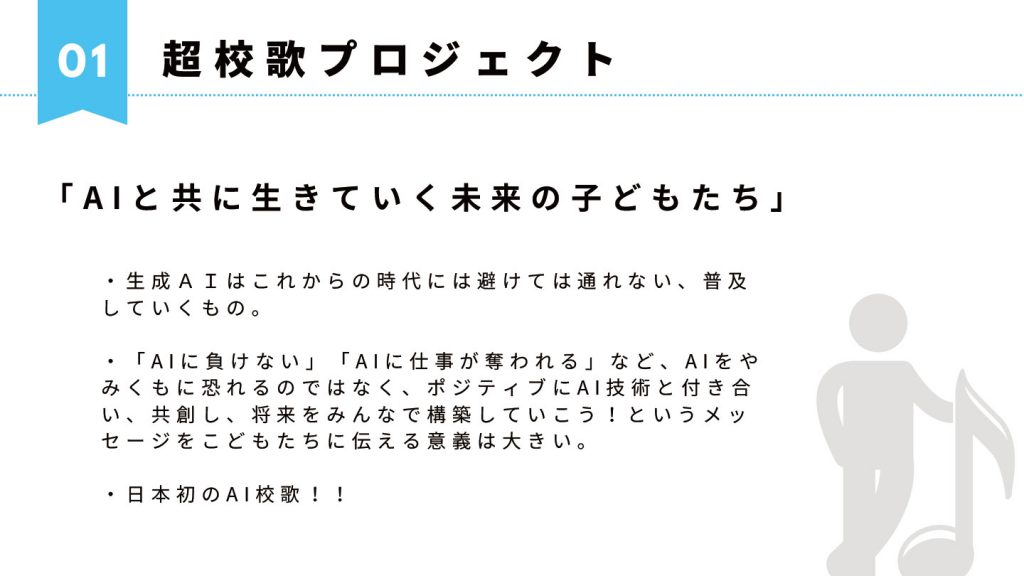
Until just a few decades ago, AI existed only in the world of movies, but today it has been integrated into every aspect of our lives, including business, and its technological advancements have been remarkable.Until now, it was said that the “Singularity”—the point at which AI would surpass human capabilities and intelligence—would arrive in 2045, but with the release of ChatGPT and other developments, some people have come to believe that we are already facing its arrival.While opinions on AI vary, I believe there is a growing consensus that “generative AI is an unavoidable part of the future and will become increasingly widespread.”
Amid these current trends, rather than blindly fearing AI—with notions like “We won’t lose to AI” or“AI will take our jobs”—but rather to engage with AI in a positive way, co-create new value, and build a bright future together! We believe there is great significance in conveying this message to the world and to children through the CHO KOUKA.
Based on these sentiments, I understand that this is likely why the mayor and members of the Board of Education reached out to us expressing their desire to collaborate on our project.
Although we are still in the research and development phase, we are looking forward to working with all of you through a process of trial and error to create what will likely be Japan’s first AI-generated school song. We aim to be pioneers in this new era and create a school song that everyone will love, so we appreciate your continued support.
Profile
-


Digital Picture Book Author Professor, Keio University; Ph.D. (Policy and Media)
Director, B Lab
Chairperson, Learning of Tomorrow (General Incorporated Association)
Chairperson, CANVASAfter graduating from the Faculty of Engineering at the University of Tokyo, he served as a visiting researcher at the MIT Media Lab before founding the NPO CANVAS and the Learning of Tomorrow Association, a General Incorporated Association, and assuming the role of representative. He serves as an outside director for Matsuya Co., Ltd., Fuji Media Holdings, Inc., and Digital Garage, Inc.
He has served on various government committees, including the Information and Communications Council of the Ministry of Internal Affairs and Communications, as well as the NHK Central Broadcasting Program Council. He also serves as a director of the Digital Signage Consortium, among other roles. He holds a Ph.D. in Policy and Media.
His publications include *Turning On Children’s Creativity!*, *What Are Smart Kids Doing on Their Smartphones?*, *The Forefront of Online Education in Japan: Considering Learning in the Post-COVID Era*,“What Is Programming Education? 45 Questions Parents Want to Know,” and “Declaration on Digital Education.” He has also provided supervision for numerous works, including “Ah, I See! Programming Education for Parents and Children Through Manga.”





































4052047885.jpg )






























