

Learning of Tomorrow
- 2020.04.06
- Online Classes (1) — Malaysia

UNESCO announced that, due to the novel coronavirus, more than 1.5 billion children worldwide are unable to attend school (as of April 6). Under the slogan “Schools may be closed, but learning must continue,” China has rapidly shifted to online education.However, in Japan, the necessary infrastructure is not in place, and it must be said that learning has come to a halt along with the school closures.
Under these circumstances
, how are other countries responding? While the examples discussed here are merely a few, I would like to share some interesting developments from abroad, based on what I know. This is the first installment.
K, a high school sophomore attending an international school in Malaysia where international students make up 80 percent of the student body, graduated from a public junior high school in Japan before moving to Malaysia on her own to study at a boarding school.
According to K, the number of COVID-19 cases in Malaysia began to surge around March 9.Then, on March 16, all students received a notification via Gmail that the school would close and switch entirely to online classes. The transition period given was two days. For students, this was a preparation period to return to their home countries and set up a study environment at home. For the school, it was a preparation period to plan how to conduct classes and conduct staff training.Ms. K decided to return to Japan on March 19 because the dormitories were closed at the government’s request. She said it was the absolute last moment she could enter the country.
Incidentally, even during the two-day transition period, simple assignments that could be submitted via Google Classroom were assigned.
As a result, I’m told that all online classes are being held via Zoom according to the regular schedule. Naturally, attendance is mandatory for everyone. At 8:30 a.m. Malaysia time (9:30 a.m. Japan time), students join the Zoom meeting set up by their teacher. A specific link is sent for each subject, and as soon as one class ends, students switch to the Zoom meeting for the next class to attend.Four classes in the morning and two in the afternoon. This routine continues every day.
1st Period (8:30–9:30)
2nd Period (9:30–10:30)
3rd Period (10:30–11:30)
- Recess: 11:30–12:00 –
4th Period (12:00–13:00)
- Lunch Break: 1:00 PM–2:00 PM –
5th Period (2:00 PM–3:00 PM)
6th Period (3:00 PM–4:00 PM)
Since the content of the lessons is determined at the teacher’s discretion, it varies widely.
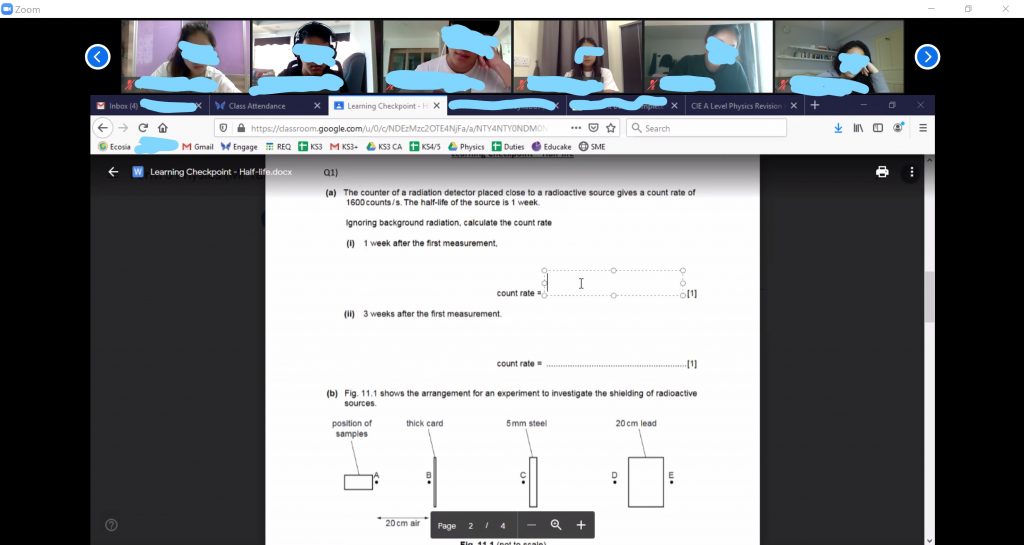
For example, the photo shows a class in the “Design Technology” course. The students are currently working on the interior design of a coffee shop.
“We’re learning how furniture, such as chairs, is utilized, and we’re designing layouts in PowerPoint to create models.”
Students share the PowerPoint presentations they’ve created on screen, and the teacher provides individual feedback to each student. Furthermore, while working independently, students constantly collaborate with classmates using various tools—such as Google Docs and video calls—to share ideas and tackle assignments together. It seems that classes are being conducted online just as they would be in person.
I asked if there were any discussion-based classes.
“Assigning a topic and having students discuss it among themselves to arrive at an answer is something we can do online as well. We often do this in classes where students write essays, such as English and history.”
For example, in a history class, the topic “Hitler’s mindset during World War II” was assigned. Using Zoom, each student expressed their opinions and shared reference websites, and the group then synthesized their ideas to write a single essay.
What about hands-on classes
?
“We also hold music and physical education classes via Zoom. In music class, students have been playing their assigned instruments, just as they do in regular classes.”
It’s surprising to hear that, based on this, the whole class is performing ensemble pieces online. First, the teacher assigns a piece, and the entire class discusses the rhythm and how to play it. Since playing simultaneously on Zoom causes a time lag, each student recorded a video of their performance, submitted it, and they then combined the clips to create a single video.
“Using ICT has really expanded our ability to collaborate as a group. In regular music class, we often practiced individually or wrote out our own sheet music, but online, that wasn’t necessary—we were able to easily create a piece of music together.”
Incidentally, since K is in charge of percussion, she played the drums.
On the other hand, physical education seems to be quite challenging. The teacher provides a list of exercises that can be done at home, and students submit videos or photos showing themselves performing them. “The teacher actually demonstrates the techniques for each exercise in a video.”
Of course, there are also lecture-style classes.Students can post questions or comments during lectures. The teacher responds to these, creating a two-way interaction.
There are also classes where students are given problems at the start and work through them on their own, asking the teacher questions about any problems they don’t understand.
When I asked Mr. K if classes were proceeding exactly as they always had, he replied immediately, “It’s no different from usual.” The fact that the transition has been so smooth suggests that classes regularly incorporate ICT, such as computers. He explained how this works in practice.
“When students enroll, they all purchase a computer or tablet and bring it to school.They also create their own Gmail accounts and are constantly communicating via computers and the internet—whether it’s submitting homework through Google Classroom or Google Docs, or receiving email notifications about class schedule changes.”
In Japan, it’s a common sight to see schools equipped with computers that are rarely used. When I asked more specifically about how often they’re used, it seems they’re utilized in virtually every class.
“We view the PowerPoint slides the teacher projects during class on our own computers and take notes right next to them. We also frequently use them for things like taking and submitting short quizzes.”
Of course, all communication with parents is digital as well. The school provides a portal site exclusively for parents, where all student grades and test results are managed.I’m told they’re currently regularly sharing information regarding the impact of the novel coronavirus.
In Japanese junior high schools, there used to be a lot of paper handouts. Isn’t that the case at schools in Malaysia? “None at all! All information is distributed via Gmail or the portal site, so there’s no need for them.”
I see…
Since they’re free to choose their computer’s operating system, I took the opportunity to ask about a common issue in Japan—how having a mix of devices can make it difficult to proceed with lessons and lead to problems.
“We don’t have any problems. Or rather, I don’t think we ever do (laughs).”
That makes sense…
Now, let’s get back to the topic of online classes. I’m currently working to transition graduate-level courses—where international students make up over 60 percent of the student body—to an online format, but time zone differences and students’ home internet connections are major challenges. How are you handling those issues?
“Since many students were unable to return home and remained in the Malaysia area, we’ve actually had surprisingly few issues with time zone differences or connection problems.”
However, it seems that in each class, there are one or two students with poor internet connections. In those cases, students are considered present as long as they submit their assignments via Google Classroom, and instructors are always available to answer questions via Gmail or Hangouts. When asked whether
regular in-person classes or online classes are more comfortable, the response was, “It depends.”“People tend to study better when they’re in an environment where they have no choice but to study, right? With online classes, it’s hard to create that environment, so it’s difficult to stay motivated. However, it’s easier to ask teachers questions online. That said, it really depends on the teacher—some are easier to ask questions of online, while others are easier to communicate with in person.”
As a side note, the difference he felt when transferring from a Japanese school to a Malaysian school was not so much the use of ICT, but rather the closer proximity to teachers, which allowed him to consult with them or ask questions immediately.
What are the challenges of online classes? “Some students end up doing things unrelated to the lesson. Since teachers can’t see what they’re doing when the mute function is on.While students are generally required to keep their cameras on, some still choose not to participate, coming up with various excuses.”
Perhaps the process of trial and error to find ways to skip class is a universal phenomenon throughout history and across cultures. Although there are pros and cons, the response among students seems generally positive: “Many say they’re satisfied because it’s amazing to be able to easily take classes even when they’re not at school, and they can ask questions.”
One last question: How long will school closures last?
“It’s undecided.”
This seems to be the same all over the world.
I hope we can share our expertise in online education across borders and bring about a global upgrade in learning once the coronavirus pandemic is over.
Profile
-


Digital Picture Book Author Professor, Keio University; Ph.D. (Policy and Media)
Director, B Lab
Chairperson, Learning of Tomorrow (General Incorporated Association)
Chairperson, CANVASAfter graduating from the Faculty of Engineering at the University of Tokyo, he served as a visiting researcher at the MIT Media Lab before founding the NPO CANVAS and the Learning of Tomorrow Association, a General Incorporated Association, and assuming the role of representative. He serves as an outside director for Matsuya Co., Ltd., Fuji Media Holdings, Inc., and Digital Garage, Inc.
He has served on various government committees, including the Information and Communications Council of the Ministry of Internal Affairs and Communications, as well as the NHK Central Broadcasting Program Council. He also serves as a director of the Digital Signage Consortium, among other roles. He holds a Ph.D. in Policy and Media.
His publications include *Turning On Children’s Creativity!*, *What Are Smart Kids Doing on Their Smartphones?*, *The Forefront of Online Education in Japan: Considering Learning in the Post-COVID Era*,“What Is Programming Education? 45 Questions Parents Want to Know,” and “Declaration on Digital Education.” He has also provided supervision for numerous works, including “Ah, I See! Programming Education for Parents and Children Through Manga.”



















4052047885.jpg )